
Georgian Bath: Roman Baths, Jane Austen and Golden Stone
There are pretty cities. And then there's Bath. Built entirely from honey-coloured limestone that glows like gold in the sunshine, Bath is the most elegant city in all of England. That's not an opinion: it's a fact UNESCO certified when they declared it a World Heritage Site in 1987.
But Bath isn't just a pretty face. Beneath its perfect Georgian facades hide two-thousand-year-old Roman baths, the literary ghost of Jane Austen, a food scene that punches above its weight, and a cultural life that defies its size. Bath is small, but it thinks big.
The Roman Baths: Where It All Began
Nearly two thousand years ago, the Romans discovered that in this corner of Britannia, hot water sprang from the earth. Not just any water: water at 46 degrees Celsius, loaded with 43 different minerals, from a thermal spring unique in all of Britain.
They built a bathing complex that became one of the most important social centres of Roman Britain: Aquae Sulis. Today, the Roman Baths are the best-preserved Roman site in northern Europe, and visiting them is a sensory journey to the 1st century.
The Great Bath is the heart of the complex: a pool of emerald green water surrounded by columns and statues that, though reconstructed in Victorian times, maintain the original grandeur. The steam rising from the hot water creates an almost mystical atmosphere, especially on winter afternoons.
But what truly moves you is what lies beneath: the original Roman foundations, the drainage systems that still work after 2,000 years, and the Temple of Sulis Minerva, whose golden goddess head is displayed in the site museum.
Tip: Combined tickets with the Fashion Museum or Victoria Art Gallery offer better value. And if you can, visit late afternoon, when torches illuminate the Great Bath.For a total immersion in historic Bath, explore our experience Classic Bath: Baths, History and Golden Stone.
Thermae Bath Spa: Bathing Like the Romans (But Better)
If the Roman Baths are for looking, Thermae Bath Spa is for feeling. This modern spa, designed by Nicholas Grimshaw, uses the same thermal water the Romans discovered, but with all 21st-century comforts.
The absolute star is the rooftop pool. Picture this: you're floating in 33-degree thermal water, with panoramic views of Bath Abbey, the Royal Crescent and the surrounding hills. When night falls and the stars appear above you while steam rises from the water... it's one of those moments that's etched into memory forever.
The Royal Crescent: The Georgian Masterpiece
The Royal Crescent is, without exaggeration, one of the most important pieces of residential architecture in the world. This crescent of 30 identical houses, built between 1767 and 1774 by John Wood the Younger, is the epitome of Georgian style: Ionic columns, perfect symmetry and that Bath limestone that changes colour with the light.
No. 1 Royal Crescent is now a museum recreating the life of a wealthy 18th-century family. In front, Royal Victoria Park stretches out like a green salon where Bath residents stroll, picnic and play croquet in summer.Jane Austen: Bath's Most Beloved Ghost
Jane Austen lived in Bath between 1801 and 1806, and the city features in two of her most important novels: Northanger Abbey and Persuasion.
The Jane Austen Centre on Gay Street (where Austen actually lived) is an interactive museum. You can dress in Regency clothing, write with quill and ink, and take tea in the Regency Tea Room on the top floor.
But the best part is walking the Bath that Austen knew. The Pump Room, beside the Roman Baths, is the tea room where Georgian society went to see and be seen. Taking tea here, with a classical music trio playing and light streaming through Georgian windows, is like stepping into one of her novels.
Every September, the Jane Austen Festival transforms Bath into a time machine: hundreds of people dress in Regency costume and promenade through the streets.
The Circus: The Hidden Jewel
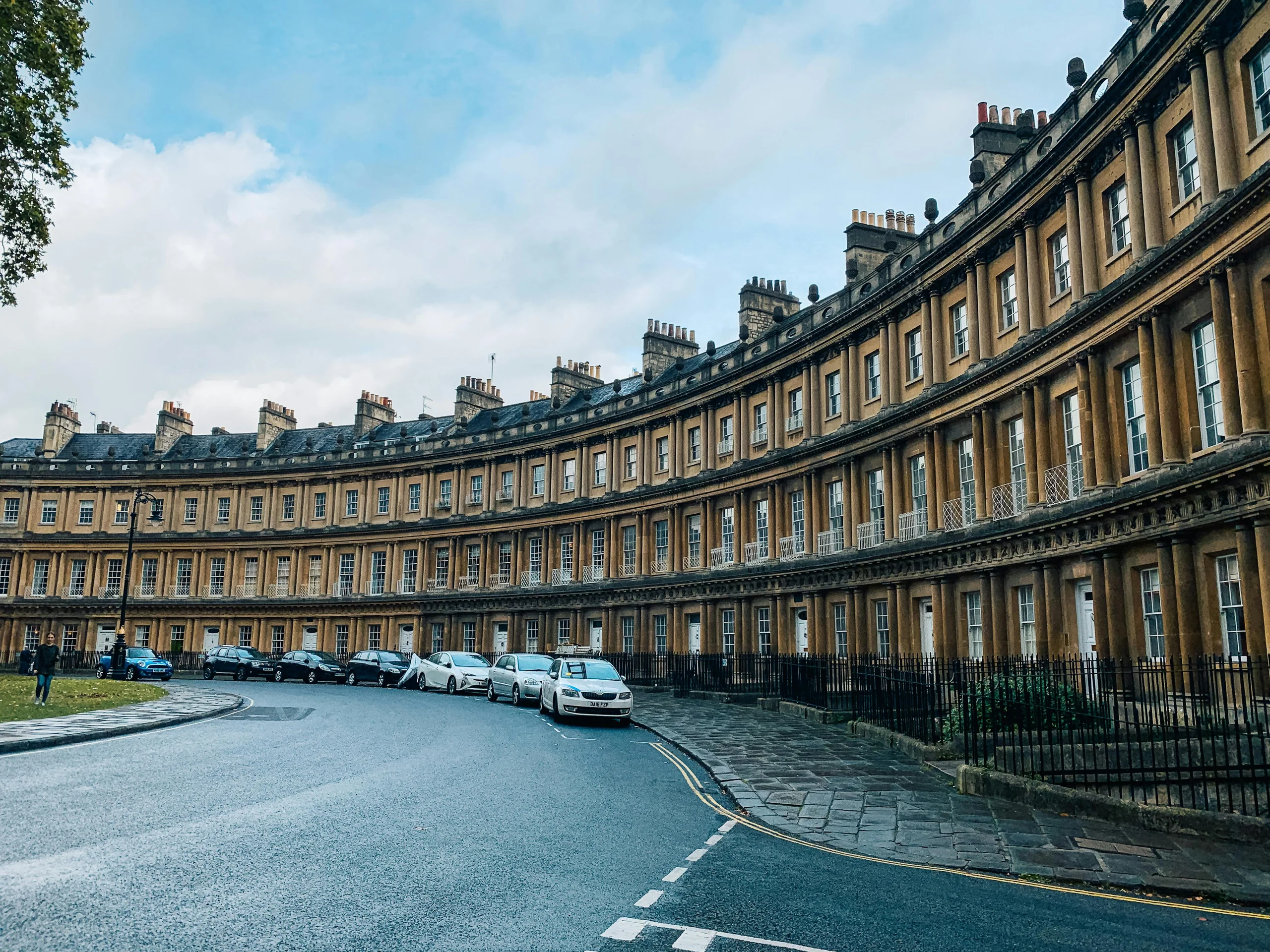
If the Royal Crescent is the star, The Circus is the hidden jewel many overlook. This perfect circle of 33 houses, designed by John Wood the Elder in 1754, was Britain's first circular street.
Fun fact: On the facades, 525 carved emblems represent the arts, sciences and trades. Look for the serpent, the globe and the musical instruments.Pulteney Bridge: The Inhabited Bridge
Pulteney Bridge is one of only four bridges in the world with shops on both sides (the others are in Venice, Florence and Erfurt). Designed by Robert Adam in 1774, it crosses the River Avon with breathtaking elegance.The best views are from Parade Gardens. At sunset, the bridge's golden stone reflects in the water, creating an image that looks like an Impressionist painting.
Bath Abbey: Perpendicular Gothic at Its Finest
Bath Abbey has occupied the city centre since the 7th century. Its fan-vaulted ceiling, one of the most beautiful in England, is a lacework of stone that seems to float. The ladder of angels on the west facade is the most photographed element.Prior Park and the Palladian Bridge
Twenty minutes uphill from the centre, Prior Park Landscape Garden hides one of Bath's least-known gems: a perfect Palladian bridge. Only four of this type exist in the world, and this is the only one in a landscape garden.
Food: Beyond the Cream Tea
Bath has a food scene that defies its size. The Bath Bun and the Sally Lunn Bun (served in Bath's oldest house, dating from 1482) are classics.
But modern Bath has raised the bar. The Pig near Bath uses only ingredients from within a 40-kilometre radius. Menu Gordon Jones offers a six-course surprise menu that changes daily. And Acorn is one of the UK's best vegetarian restaurants.
Discover local food with Bath for Foodies: Flavours Among Golden Stone.
Getting Around Bath
Bath is deliciously small and walkable. The entire historic centre can be crossed on foot in fifteen minutes. From Bath Spa station, you're five minutes' walk from the Roman Baths, Abbey and Royal Crescent. The train from London Paddington takes just 90 minutes.
My perfect itinerary:Bath is proof that a city doesn't need to be big to be extraordinary. Every street, every facade, every ray of sunshine reflected in the golden stone reminds you that you're somewhere beauty isn't accidental: it's intentional, meticulous and absolutely irresistible.
Because Bath doesn't just glow from the sun... it glows because it was built to shine.