Bruges: Medieval Charm, Canals, Chocolate and Beer in the Jewel of Flanders
There are cities that seem to have been drawn with quill and watercolour on an ancient manuscript. Bruges is one of them. From the moment you set foot on its cobblestone streets, you understand that this place decided to pause on some forgotten page of the fifteenth century and stay there, immune to the passage of time, wrapped in the aroma of melted chocolate and the foam of Trappist beer.
But Bruges is no frozen relic. Beneath its mantle of Gothic stone and brick beats a living city, with artisans perpetuating centuries-old crafts, brewers innovating without betraying tradition, and chocolatiers elevating cacao to the status of art. This is the definitive guide to discovering a city that deserves far more than a day trip from Brussels.
The Markt: The Heart of the Medieval City
Everything in Bruges begins and ends at the Markt square. This rectangular space, flanked by guild houses with colourful stepped facades, has been the commercial and social epicentre of the city since the Middle Ages. Here the wool and spice markets were held that made Bruges one of the richest cities in Europe during the thirteenth and fourteenth centuries.
Today the former guild houses contain restaurants and cafes with terraces from which to watch the comings and goings of Bruges life. On Wednesday mornings, a small local produce market returns the square to its original purpose. It is the best place to begin understanding why this city was declared a UNESCO World Heritage Site.
Local tip: Avoid restaurants with menus in six languages posted at the door. The best places to eat are two streets away from the square, where prices drop and quality rises.The Belfry: 366 Steps to the Skies of Flanders
Dominating the Markt at 83 metres tall, the Belfort (Belfry) of Bruges is far more than a tower with a view. It is the symbol of civic power that the Flemish bourgeoisie built to rival the cathedrals of the Church. Its 366 steps (one more than the days of the year, a reminder of its builders' ambition) lead to a panorama that justifies every drop of sweat.
From the top, a sea of red rooftops stretches to the horizon, dotted with church spires and, on clear days, the distant glimmer of the North Sea. Inside the tower, the carillon of 47 bells still marks the hours with melodies that have accompanied daily life in Bruges for centuries.
Fun fact: The staircase narrows dramatically in the final stretches. If you suffer from claustrophobia, think twice. But if you make it to the top, the view will make you forget everything else.The Canals: The Venice of the North
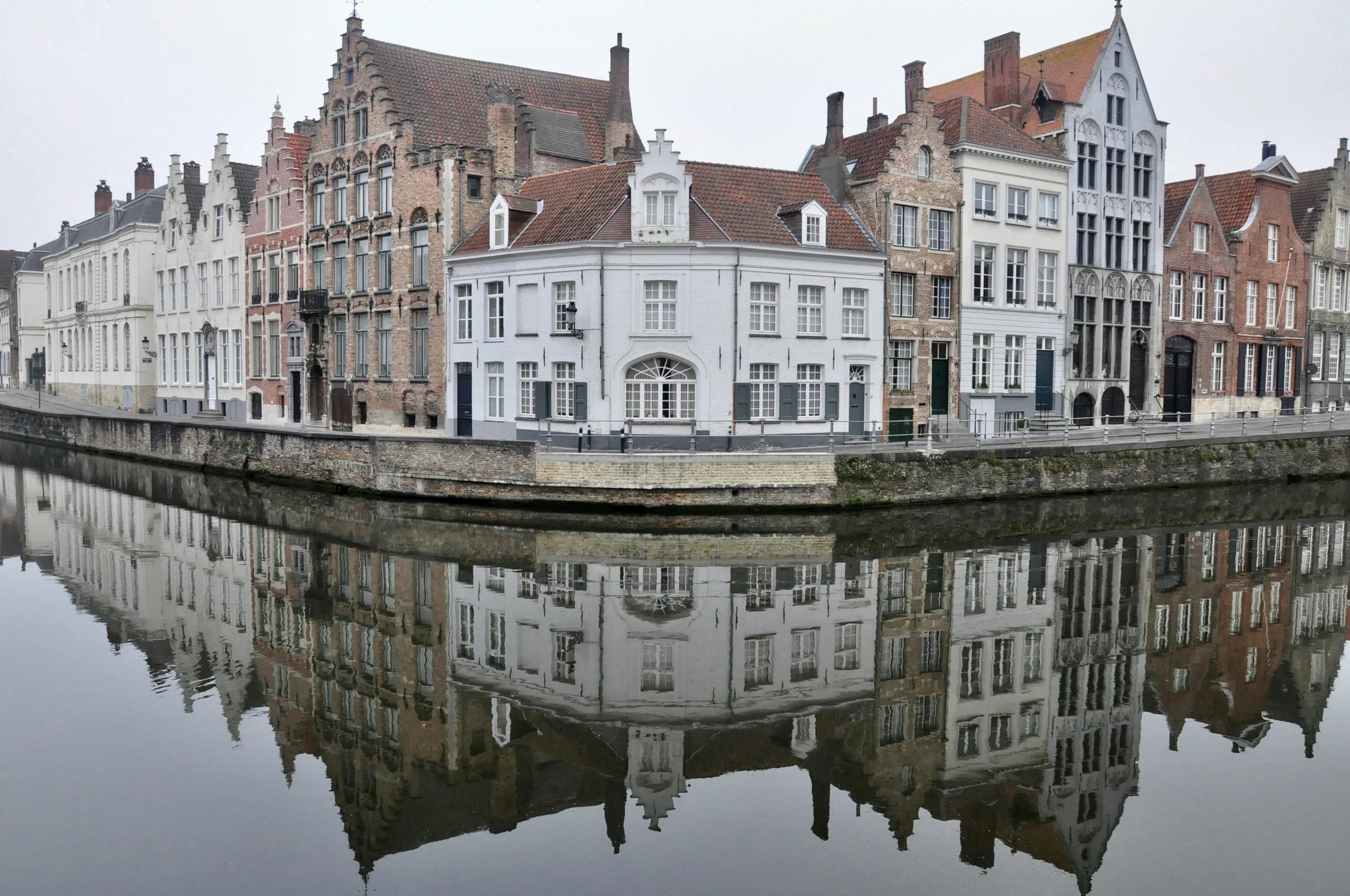
If the Belfry is the vertical heart of Bruges, the canals are its circulatory system. The network of waterways threading through the historic centre is not an aesthetic whim: it was the infrastructure that connected Bruges to the North Sea and, through it, to the entire world.
In the thirteenth century, English wool, Eastern spices, French wines and Flemish cloth circulated through these waters, generating unprecedented wealth. Today the same canals reflect the brick facades of the fourteenth and fifteenth centuries, moss-covered stone bridges and willows bending their branches toward the water.
The canal boat tour is the most iconic experience in Bruges. For half an hour, a local boatman guides you beneath medieval bridges, past secret gardens visible only from the water, and before perspectives of the city that no walking tour can offer. The evening light on the canals creates a spectacle that no Instagram filter can improve.
Tip: Board first thing in the morning or after 5 PM. Between 11 AM and 3 PM, queues can exceed 45 minutes and the experience loses its intimacy.Artisanal Chocolate: The Sweet Obsession of Bruges
Bruges has more than fifty artisanal chocolate shops, a concentration unmatched by any other city on the planet. And we are not talking about supermarket chocolate: here every bonbon is a piece of gastronomic goldsmithery.
The Belgian chocolate tradition dates back to the seventeenth century, when cacao arrived at Flemish ports from the American colonies. But what distinguishes Bruges is the survival of the artisanal craft in the face of industrialisation. Here, master chocolatiers still personally select the beans, control tempering temperature to the exact degree and create combinations that defy imagination.
Among the essential stops:
Do not leave Bruges without trying an authentic hot chocolate: pure cacao melted into hot milk, with no powders or shortcuts. It is a religious experience.
Beer: Brugse Zot and the Underground Pipeline
If chocolate is the sweet soul of Bruges, beer is its festive soul. Belgium is the only country in the world where beer culture has been declared UNESCO Intangible Cultural Heritage, and Bruges honours that title with fervour.
The De Halve Maan (The Half Moon) brewery is the only active brewery within the historic centre. Founded in 1856, it produces the legendary Brugse Zot ("The Fool of Bruges"), a high-fermentation blonde with fruity notes, a silky body and a dry finish that makes it the perfect companion for any Flemish lunch.
But the most extraordinary thing about De Halve Maan is not what you see but what lies underground: a three-kilometre beer pipeline connecting the brewery to its bottling plant outside the historic centre. Inaugurated in 2016, this underground conduit was partially crowdfunded. Donors who contributed more than 7,500 euros received an irresistible reward: free beer for life.
The guided tour includes a tasting on the rooftop with panoramic views of the Belfry. It is one of the best experiences in Bruges.
For Trappist beer lovers, the nearby Westvleteren Abbey produces what many consider the world's best beer. It is not sold in shops or bars: you must reserve by phone and collect it at the abbey itself.
The Lake of Love and the Beguinage: Medieval Silence
At the southern edge of the historic centre, far from the tourist bustle, two of Bruges's most magical corners hide in plain sight.
The Minnewater (Lake of Love) is a pond surrounded by ancient trees where white swans glide in almost supernatural silence. According to legend, couples who cross the bridge over the lake will be united forever. Whether true or not, the place possesses a beauty that invites contemplation.
Just beside it, the Begijnhof (Beguinage) is one of the most serene corners in all of Belgium. Founded in 1245, this cluster of whitewashed houses around a tree-lined garden was home to the beguines, lay religious women who led lives of prayer and artisanal work without belonging to any monastic order. Today it is inhabited by Benedictine nuns, and the silence within its walls contrasts dramatically with the animation surrounding it.
In spring, when daffodils blanket the garden in yellow, the Beguinage achieves a beauty that seems drawn from another century.
Bruges Lace: A Craft That Refuses to Disappear
For centuries, Bruges was one of the world centres of bobbin lace production. This artisanal tradition, requiring almost superhuman patience and precision, survives in a handful of workshops and shops in the historic centre.
The Kantcentrum (Lace Centre) offers live demonstrations of this ancestral technique. Watching the lacemakers work, their fingers moving dozens of bobbins at impossible speed over a pin-studded cushion, is mesmerising. Each piece can take weeks or months to complete.
If you are looking for an authentic souvenir of Bruges, a piece of handmade lace is infinitely more valuable than any fridge magnet.
Practical Tips for Your Visit
A City That Deserves Your Time
Bruges is not a place to rush through. It is a city that asks to be savoured slowly, like a dark chocolate praline or a well-chilled Brugse Zot. Every canal, every stepped facade, every carillon melody is an invitation to pause, look and feel.
There are cities you visit and cities you inhabit, even if only for a few hours. Bruges belongs to the second category. And when you leave, a part of you will remain floating on those still waters, among the swans and the reflections of medieval towers.
---
Discover all the experiences Bruges has in store for you at letsjaleo.com/brujas. Canals, chocolate, beer, Flemish art and hidden corners: your adventure in the Venice of the North starts here.