
# Bruges, the Venice of the North: Medieval Canals and Belgian Chocolate
Some places seem invented. Bruges is one of them.
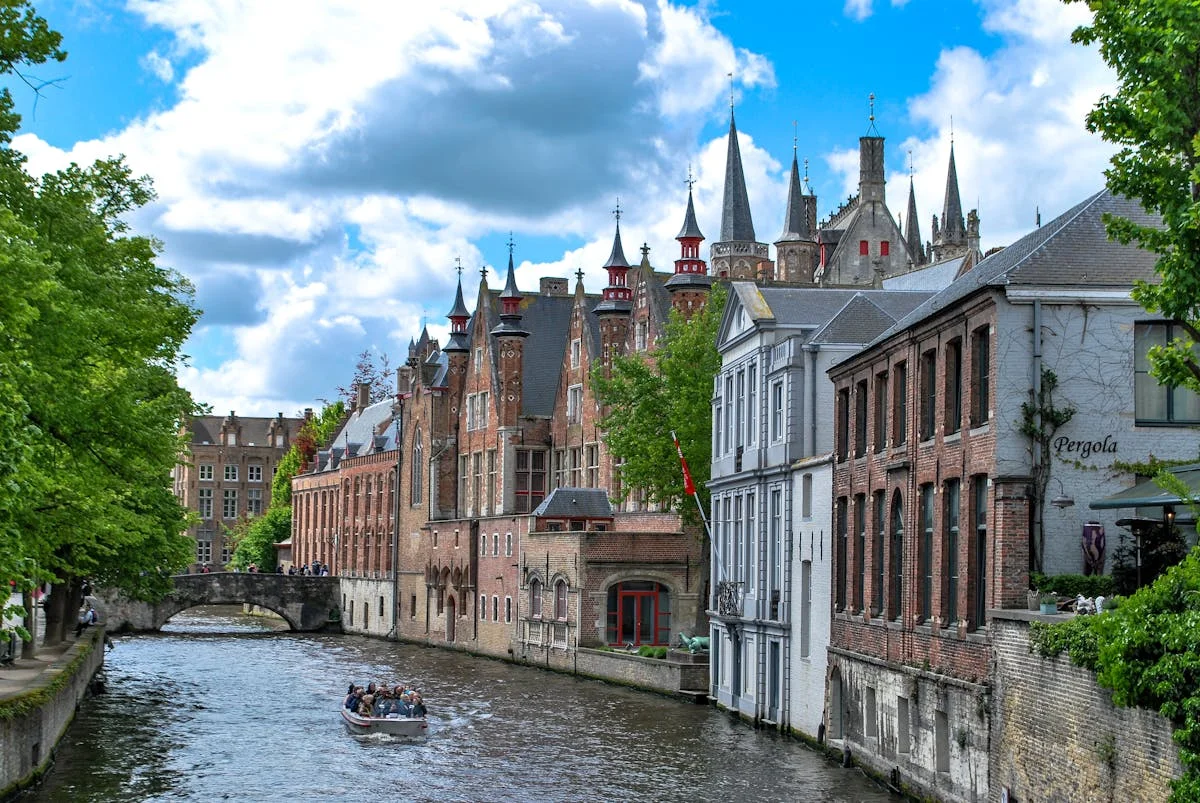
When you walk along its canals for the first time, with the brick facades reflected in the still water and swans gliding silently beneath centuries-old stone bridges, it's hard to believe what you see is real. It looks like a fairytale set, a Flemish miniature come to life, a city someone drew in a fifteenth-century illuminated manuscript that, by some miracle, has survived intact to this day.
But Bruges is not a museum frozen in time. Beneath its medieval postcard appearance beats a living city, with a chocolate culture that rivals Switzerland's, a brewing tradition that dates back to Trappist monks, and a food scene that goes far beyond tourist waffles.
The Canals: The City's Liquid Heart
Bruges owes its name to the Old Norse "bryggia," meaning wharf. And water remains its defining element. The network of canals threading through the historic center isn't decorative: it was the very reason the city existed.
In the thirteenth century, Bruges was one of Europe's most important trading ports. The canals connected the city to the North Sea and, through it, to the world. English wool, Eastern spices, French wines, and Flemish cloth circulated through the same waters that today reflect the stepped facades of the fourteenth and fifteenth centuries.
The canal boat tour is, without doubt, the most emblematic experience in Bruges. For thirty minutes, a local boatman guides you beneath medieval bridges, past secret gardens visible only from the water, and before facades that tell six centuries of commercial, artistic, and religious history.
Local tip: Avoid boats between 11 AM and 3 PM, when queues can exceed an hour. First thing in the morning or late afternoon, the experience is infinitely more intimate. The sunset light on the canals is, simply, one of the most beautiful spectacles in Europe.To experience the full medieval Bruges, from the belfry to the canals and the Flemish Primitives, don't miss the cultural route through the belfry, canals, and Flemish Primitives.
The Belfry: 366 Steps to Eternity
The Belfort of Bruges has dominated the city skyline since the thirteenth century. At 83 meters high with 366 steps (yes, one more than the days of the year), this Gothic bell tower is much more than a viewpoint: it is the symbol of medieval civic power.
From its summit, the view is breathtaking. A sea of red and ochre rooftops extends as far as the eye can see, dotted with church spires, hidden courtyards, and on clear days, the distant glimmer of the North Sea. It's the same view that fifteenth-century Flemish merchants contemplated when Bruges was one of the richest cities in the world.
Inside the belfry, the carillon of 47 bells still rings every quarter hour, filling the Markt square with a melody that has been floating over the city's rooftops for centuries.
Fun fact: The staircase narrows as you climb, and the final stretches are so tight that only one person fits. The ascent isn't suitable for the claustrophobic, but the reward at the top justifies every step.The Flemish Primitives: When Bruges Was the Center of the Art World
Before the Italian Renaissance or Spain's Golden Century existed, Bruges was already the world capital of painting. Here worked the masters of the Flemish Primitives: Jan van Eyck, Hans Memling, Gerard David, and other geniuses who revolutionized Western painting with their mastery of perspective, light, and detail.
The Groeninge Museum houses one of the world's most important collections of Flemish Primitives. Jan van Eyck's "Virgin of Canon Van der Paele," with its near-photographic level of detail, or Hieronymus Bosch's "Last Judgment," with its universe of fantastic creatures, are works that merit the trip to Bruges on their own.
But the crown jewel is St. John's Hospital, one of Europe's best-preserved medieval hospitals, converted into a museum housing Hans Memling's masterpieces. The "Shrine of Saint Ursula," a tiny Gothic ark painted with scenes of exquisite precision, is one of the most extraordinary pieces of European medieval art.
The connection between Bruges's commercial wealth and its artistic splendor is no coincidence. Flemish merchants financed the painters, and the painters immortalized the merchants. Every altarpiece, every portrait, every miniature is a document of an era when art and commerce fed each other.
Chocolate: Bruges's Other Religion
If the Flemish Primitives are the artistic soul of Bruges, chocolate is its sweet soul. The city has more than fifty artisanal chocolate shops, a density unmatched by any other city in the world.
And we're not talking about industrial chocolate. In Bruges, chocolate is a craft passed down through generations, with master chocolatiers who personally select cacao beans, control every phase of the process, and create pieces that are both works of art and palate pleasures.
Among the essential chocolate shops:
For a total immersion in the flavors of Bruges, from artisanal chocolate to Trappist beer and Flemish cuisine, the foodie route through chocolate, beer, and Flemish gastronomy will guide you to the best stops.
Beer: The Other Liquid Gold
Bruges isn't just the city of chocolate. It's also one of Belgium's beer capitals, a country where beer is UNESCO Intangible Cultural Heritage.
The De Halve Maan (The Half Moon) brewery is the only active brewery within the historic center. Founded in 1856, it produces the celebrated Brugse Zot ("The Fool of Bruges"), a high-fermentation blonde with fruity notes and a dry finish that is the city's unofficial beer. The guided tour includes a tasting on the rooftop with panoramic views of the belfry.
But the truly extraordinary thing is what lies underground: a beer pipeline of three kilometers connecting the brewery to its bottling plant outside the center. Inaugurated in 2016, this underground conduit was partially crowdfunded, offering donors free beer for life in exchange for their contributions.
For Trappist beer lovers, the nearby Westvleteren abbey produces what many consider the world's best beer. It's not sold in shops: you must reserve by phone and collect it at the abbey itself.
The Beguinage: Medieval Silence in the Heart of the City
The Begijnhof (Beguinage) of Bruges is one of the most serene corners of all Belgium. Founded in 1245, this cluster of whitewashed houses around a tree-lined garden was home to the beguines, lay religious women who led lives of prayer and work without belonging to any monastic order.
Today it's inhabited by Benedictine nuns, and the silence that reigns within contrasts dramatically with the tourist bustle surrounding it. In spring, when daffodils cover the garden in yellow, the Beguinage achieves a beauty that seems from another century.
Just beside it, the Minnewater (Lake of Love) completes the romantic picture. According to legend, couples who cross the bridge over the lake will be united forever. Legend or not, the place is of undeniable beauty.
To capture these postcard-perfect corners and many more, explore the Instagrammable route through Bruges's canals, towers, and picture-perfect spots.
Getting Lost on Purpose: The Art of the Slow Walk
Bruges is a city for walking without hurry and without a map. Its cobblestone streets, narrow alleys, and tiny squares hide surprises no itinerary can predict: an ivy-covered inner courtyard, a lace shop where a craftswoman works with bobbins as her great-grandmothers did, a tavern serving stoofvlees (beef stew with beer) just as they made it in the sixteenth century.
Some essential corners off the tourist trails:
If that's exactly what you're looking for -- letting yourself be carried by the unhurried rhythm of a city that invites slowness -- the slow route through the gentle walks of the Venice of the North is designed for you.
Practical Tips for Your Visit
A City That Tastes of History
Bruges isn't just pretty. It's significant. Every stone, every canal, every Flemish Primitive painting reminds us that there was a time when this small city in northern Europe was the center of the commercial and artistic world. That the beauty we admire today as a relic was once the everyday expression of a prosperous, sophisticated society deeply in love with art.
And that emotion is what distinguishes Bruges from any medieval theme park. Here nothing is recreation: everything is real. The houses where merchants lived still stand. The canals where goods once navigated are still full of water. The paintings they commissioned from the world's finest painters still hang just meters from where they were painted.
---
Bruges isn't visited: it's inhabited, even if only for a day. And whoever inhabits it discovers that there are cities capable of stopping time without stopping life.