
# Ghent, the Medieval Rebel: Art, Canals, and Cuberdons
If Bruges is the city that stopped in time, Ghent is the one that never stopped. Ever.
This city has been Flanders' rebel for centuries. In the Middle Ages, its weavers rose against the counts. In the nineteenth century, its workers led Europe's first strikes. And today, in the twenty-first century, Ghent remains Belgium's most defiant, creative, and surprising city.
But don't be fooled by its punk spirit: Ghent is also one of the most beautiful cities on the continent. Its three medieval towers form one of Europe's most spectacular urban silhouettes, its canals rival Amsterdam's, and its cathedral houses one of the most important artworks in history: The Mystic Lamb by the Van Eyck brothers.
The Three Towers: The Silhouette That Defines Ghent
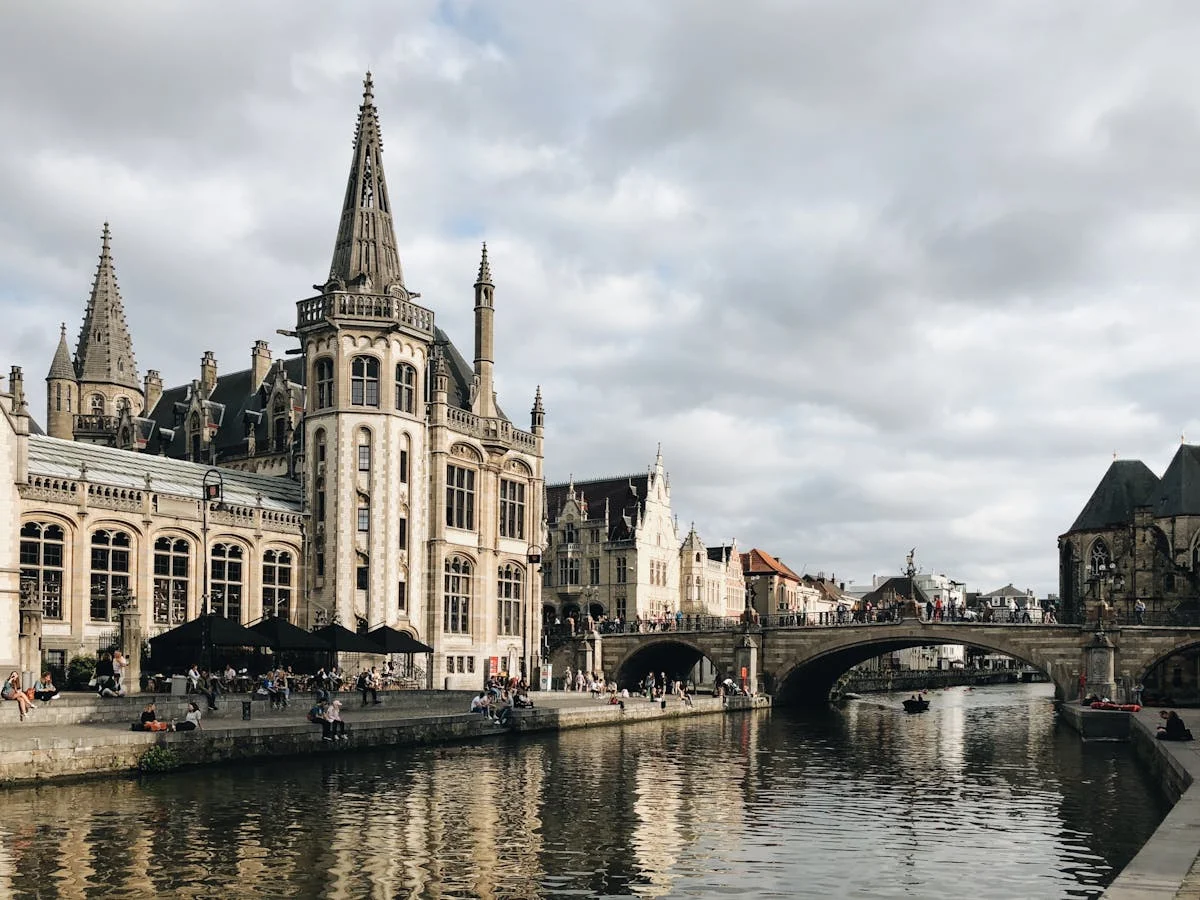
Few urban views in Europe are as striking as Ghent's three towers aligned against the sky. From Saint Michael's Bridge, the three succeed each other in perfect sequence: Saint Nicholas' Church, the municipal Belfry (Belfort), and Saint Bavo's Cathedral.
Each tower tells a different story. Saint Nicholas, with its sober and powerful Scheldt Gothic, represents the power of the medieval guilds. The Belfry, at 91 meters with its golden dragon atop, symbolizes the civic pride of a city that always refused to submit. And Saint Bavo's, the cathedral, is the temple of Flemish art, home to the world's most famous polyptych.
Climbing the Belfry is an experience that goes beyond the views. Inside, an interactive exhibition traces the city's history through the bells that for centuries set the rhythm of Ghent life.
Fun fact: The golden dragon crowning the Belfry was brought from Constantinople by Flemish crusaders in 1204. It has been watching over the city for more than eight hundred years.To experience the full monumental Ghent, from the three towers to the medieval castles, don't miss the monumental route through Flemish art and medieval castles.
The Mystic Lamb: The Masterpiece That Changed Art History
Inside Saint Bavo's Cathedral lies The Adoration of the Mystic Lamb, the polyptych painted by the brothers Hubert and Jan van Eyck in 1432. It's no exaggeration to say this work changed the history of Western painting forever.
What Van Eyck achieved is unprecedented: a level of microscopic detail so precise that modern botanists can identify more than forty different plant species in the central panel. The reflections on knights' armor, water droplets on flowers, fabric textures -- all painted with a precision that wouldn't be matched until the invention of photography, four hundred years later.
But The Mystic Lamb is also the most stolen artwork in history. It was looted by Napoleon, coveted by Hitler (who hid it in an Austrian salt mine), and one of its panels was stolen in 1934 and never recovered.
After a restoration spanning more than a decade, the polyptych can now be seen in all its original splendor in the cathedral's Villa Chapel, with a lighting system that reveals every detail of this absolute masterpiece.
Graslei and Korenlei: Ghent's Living Room
If the three towers are Ghent's postcard, Graslei and Korenlei are its soul. These two wharves facing each other on the banks of the River Lys form one of Europe's most beautiful architectural ensembles.
The Graslei facades are a living catalog of Flemish architecture: the House of the Grain Measurers (Gothic), the Masons' House (Baroque), the Grain Warehouse (reconstructed Romanesque). Each building tells the story of a different guild, a different era, and together they compose a visual symphony six centuries in the making.
At sunset, when golden light bathes the facades and young university students sit on the wharves with beers in hand, the Graslei achieves an atmosphere that blends medieval and contemporary in a unique way.
Local tip: The best time to photograph the Graslei is early morning. But the best time to experience it is at sunset, with a beer on the wharf.To capture these corners and many more, explore the Instagrammable route through the three towers, graffiti, and canals.
The Gravensteen: Castle of the Counts
In the heart of Ghent rises the Gravensteen, a medieval castle that looks straight out of a movie. With its battlements, moat, dungeons, and keep, it's one of the best-preserved castles in Western Europe.
Built in 1180 by Count Philip of Alsace after returning from the Crusades, the Gravensteen was designed to impress and intimidate Ghent's rebels. The visit is entertaining and sometimes surprisingly funny: the audio guide, with an irreverent tone very typical of Ghent, turns the tour into an experience that delights adults and children alike.
For a complete family experience with the Gravensteen, canal boats, and famous cuberdons, the family route through castles, boats, and cuberdons is designed for all ages.
Cuberdons: Ghent's Sweet Secret
If Bruges has chocolate, Ghent has cuberdons. These small pink cones, with a crunchy shell outside and a gelatinous raspberry interior, are the city's most emblematic sweet and one of Belgian gastronomy's best-kept secrets.
Cuberdons are sold at street stalls throughout the center, but the most authentic place to buy them is the Groentenmarkt (Vegetable Market), where rival vendors compete for each customer with a passion that borders on the comical. The rivalry between stalls is legendary and part of local folklore.
But Ghent's gastronomy goes far beyond cuberdons. The city is the birthplace of waterzooi, a creamy chicken or fish stew that is Flanders' national dish. And its beer scene is among Belgium's richest.
To immerse yourself in Ghent's flavors, from waterzooi to cuberdons and Trappist beers, don't miss the foodie route through waterzooi, cuberdons, and Trappist beers.
Patershol: Ghent's Most Charming Neighborhood
Just behind the Gravensteen hides Patershol, a labyrinth of cobbled alleyways that is Ghent's oldest and most charming neighborhood. In the Middle Ages it was a quarter of tanners and artisans; today it's the gastronomic quarter par excellence.
But the best of Patershol isn't its restaurants, it's its streets. Walking aimlessly through these narrow lanes, with their medieval facades, inner courtyards, and cats dozing on windowsills, is one of the most pleasurable experiences Ghent offers.
The Arts Quarter: Graffiti and Creativity
Ghent is one of Europe's street art capitals. The Werregarenstraat, known as Graffiti Alley, is an open-air gallery where local and international artists constantly renew the murals. But street art isn't limited to this street: throughout the city you'll find works ranging from classic graffiti to conceptual installations.
This creative, rebellious dimension is what sets Ghent apart from other medieval cities. Here, a Gothic palace can coexist with a contemporary art mural without anyone batting an eye.
Europe's Vegan City
Ghent holds another title few talk about: it was the first city in the world to establish an official vegetarian day (Donderdag Veggiedag, or Veggie Thursday) in 2009. Since then, its plant-based food scene has only grown.
Restaurants like Le Botaniste and Komkommertijd prove that plant-based gastronomy can be as sophisticated as any other.
The River Lys: Ghent's Backbone
Ghent is a city of water. The River Lys, which joins the Scheldt here, has always been the backbone of urban life. A boat ride through the canals reveals a different Ghent from what you see from the streets.
For those who prefer a slow pace, a walk along the Lys banks, especially around the Coupure and Citadelpark gardens, offers a green, serene counterpoint to the bustle of the center.
If you're looking for that unhurried rhythm, the slow route through hidden gardens and walks along the Lys is designed for you.
Practical Tips
The City That Never Surrendered
Ghent isn't easy to classify. It's medieval yet modern, rebellious yet elegant, a university town yet historic. It's a city that has been reinventing itself for centuries without ever losing its essence.
---
Ghent isn't visited: it's lived. And whoever lives it discovers that there are cities capable of being ancient and modern at the same time, without apologizing for either.