Strasbourg Bleisure: Business and Alsatian Charm
Strasbourg lives between two worlds — and that's precisely what makes it irresistible for business travellers.
7h
Duration
5
stops
09:00 - 16:00
Schedule
€€ - Gratuito (plataforma: 8€)
Price range
Strasbourg Bleisure: Business and Alsatian Charm is a curated one-day experience in Estrasburgo with 5 activities: European Parliament, Strasbourg Cathedral, Petite France, Winstub Le Clou and 1 more. Estimated duration: 7h. Price range: €€ - Gratuito (plataforma: 8€).
Strasbourg lives between two worlds — and that's precisely what makes it irresistible for business travellers. European capital, heart of Alsace, a living frontier between France and Germany: here suits rub shoulders with half-timbered medieval houses and plenary sessions end with a glass of Grand Cru Riesling.
This experience is designed for the business traveller who refuses to reduce Strasbourg to a meeting room and a hotel. It's bleisure in its purest form: productivity in the morning, cultural discovery at noon, Alsatian gastronomy in the afternoon and vineyards at sunset. Everything fits into a single day without rushing or compromise.
### The route
The day begins at the **European Parliament**, where continental democracy takes on a physical dimension that impresses even the most seasoned political observers. The visit to the hemicycle and the Parlamentarium Simone Veil gives you perspective — and an unbeatable dinner conversation topic.
From the European quarter, the route takes you to the medieval heart of the city. **Notre-Dame Cathedral** appears between the narrow streets like a vision of pink sandstone: 142 metres of Gothic spire that for centuries was the tallest thing humanity had ever built. The astronomical clock, with its automata dating from 1574, still measures time with a precision that puts any smartwatch to shame.
Then you descend into **Petite France**, where the channels of the Ill reflect the colourful facades of the old tanners' quarter. The pace changes here: you walk slowly, look twice, and understand why UNESCO protects every stone in this place. It's the pause you need before what comes next.
Lunch at **Winstub Le Clou** is an unfiltered immersion in Alsatian cuisine: crispy tarte flambée, choucroute garnie with artisan sausages, and a wine list that is a journey in itself. At an oak table from the sixteenth century, any business conversation becomes more human.
The day culminates on the **Alsace Wine Route**, where terraced vineyards between the Vosges and the Rhine remind you that there are few things in the world a good Gewurztraminer can't improve. A tasting in a centuries-old cellar is the perfect ending to a day that proves working and enjoying life aren't incompatible verbs.
### Strasbourg for business travellers
What makes Strasbourg special as a bleisure destination is its scale. Everything is close: the Parliament to the cathedral is 20 minutes by tram, from the cathedral to Petite France five minutes on foot. You don't waste time commuting — you gain it in experiences. And the fact that it's the European capital guarantees first-class hotel and dining infrastructure, designed for an audience that values efficiency as much as quality.
### Why this experience works
This isn't a tourist itinerary adapted for business travellers — it's a day designed from the ground up for someone with one foot in the meeting and the other in the city. Each stop brings something different: institutional perspective, monumental beauty, urban romance, authentic gastronomy and wine culture. By the end of the day, you won't have visited Strasbourg — you'll have understood it.
Strasbourg is the perfect city for the business traveller who wants to make the most of every minute. European capital par excellence, it houses the European Parliament and the Council of Europe, yet its historic centre — a UNESCO World Heritage Site — looks like a fairytale setting.
Petite France, with its half-timbered houses reflected in the Ill canals, is Alsace's most photogenic quarter. Steps away, Notre-Dame Cathedral rises with its 142-metre spire. Its astronomical clock, a Renaissance mechanical marvel, has been running since 1574.
Alsatian cuisine fuses the best of France and Germany: crispy flammekueche, choucroute garnie, and the country's most elegant white wines. A traditional Winstub is the perfect place to close deals over a glass of Grand Cru Riesling.
Daily Itinerary
European Parliament
You arrive at Strasbourg's European quarter and the first thing that hits you is the scale. The European Parliament building rises before you like an architectural statement of intent: glass, steel and curves reflecting the Alsatian sky. Designed by Paris-based Architecture-Studio and completed in 1999, the structure is shaped like an unfolding wing — a deliberate symbolism about the openness and transparency that European democracy aspires to represent. It covers 220,000 square metres. When you step inside, you understand why. **The hemicycle** is the heart of the building. This is where the 705 MEPs from 27 member states convene for the 12 annual plenary sessions held in Strasbourg — the rest of the legislative work happens in Brussels, but the official seat, by treaty, is here. The chamber impresses with its flawless acoustics, engineered so that every speech is heard clearly in all 24 official EU languages. The simultaneous interpretation headsets are a piece of linguistic engineering unmatched anywhere in the world. The free guided tour covers the hemicycle, the press room — where decisions that have changed the lives of 450 million Europeans have been announced — and the **Parlamentarium Simone Veil**, named after the first President of Parliament elected by universal suffrage. This interactive visitors' centre isn't your typical dull institutional museum: multimedia installations put you in the shoes of an MEP during a legislative negotiation, show you how a directive affects your daily life, and tell the story of the European project from the ruins of 1945 to the present. From the upper terrace, the views complete the picture: the **Council of Europe**, the **European Court of Human Rights** and the ARTE buildings — the Franco-German channel — stretch before you forming a campus of institutions that exists nowhere else on the planet. Strasbourg is the only city in the world that hosts European institutions without being a nation's capital, a status earned after centuries of Franco-German wars that turned this border city into a symbol of reconciliation. **Practical tip**: the visit is free, lasts approximately 90 minutes and requires advance booking on the Parliament's website. Bring ID. If you coincide with a plenary session (generally one week per month), you can attend as a member of the public from the gallery — an experience no business traveller should miss if the opportunity arises.
1 Allée du Printemps, 67070 Strasbourg, Francia

Strasbourg Cathedral
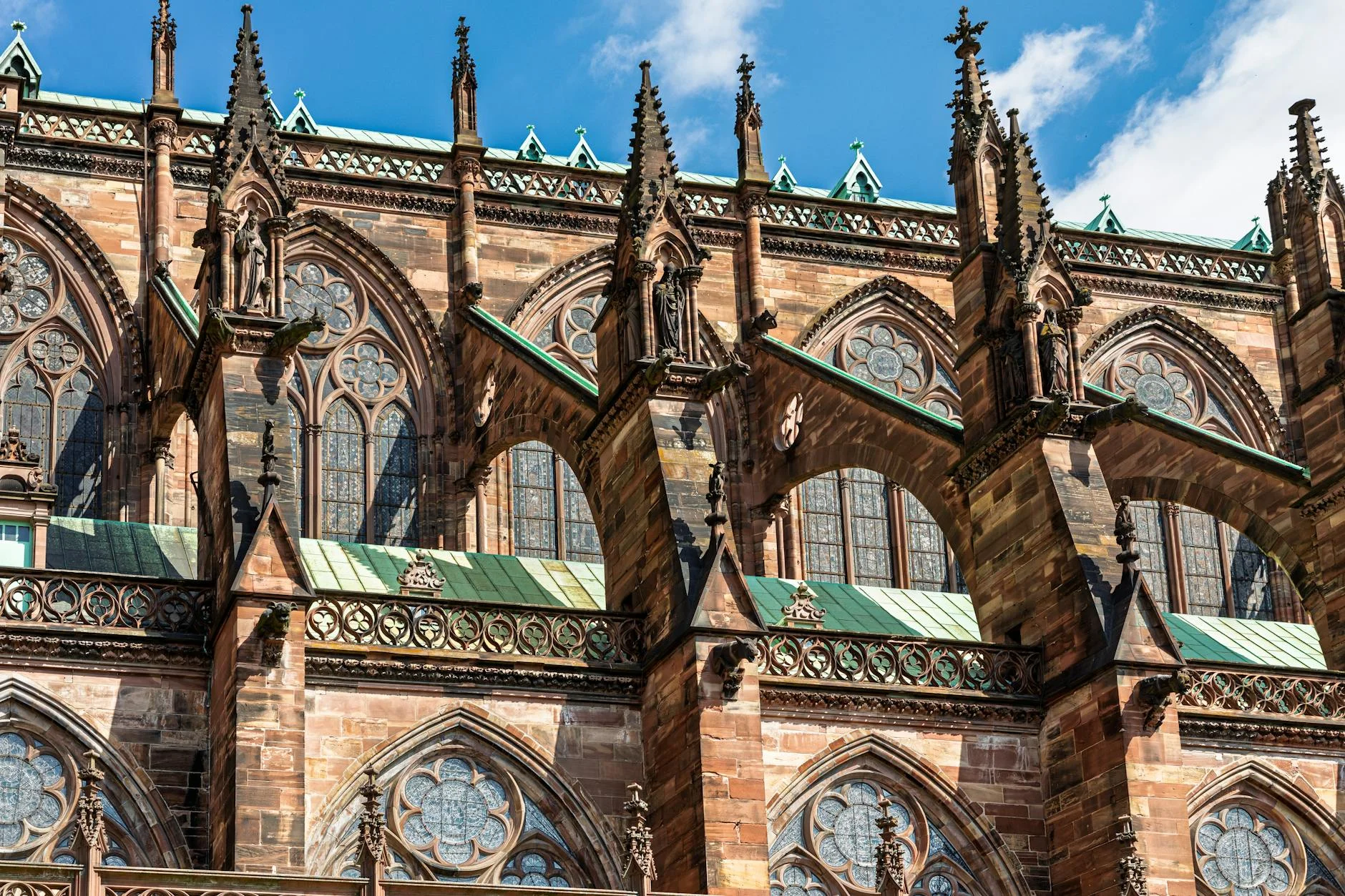
You see it before you arrive. From anywhere in Strasbourg's old town, the spire of **Notre-Dame Cathedral** pokes above the rooftops like a finger of pink stone pointing at the sky. At 142 metres tall, it was for more than two centuries — from 1647 to 1874 — the tallest structure ever built by human hands. That fact feels modest when you're standing at the foot of the facade looking up. The western facade is a book of stone. More than 300 figures sculpted in **pink Vosges sandstone** narrate scenes from the Old and New Testaments with a level of detail that requires several minutes of observation to begin appreciating. The stone changes colour with the time of day: pale pink in the morning, coppery at noon, almost golden at sunset. Victor Hugo called it 'a prodigy of the gigantic and the delicate' — and for once, he wasn't exaggerating. Construction began in 1015 in Romanesque style and continued for over four centuries, pivoting to Gothic in the thirteenth century. The result is a cathedral containing layers of architectural history: the original Romanesque crypt, the thirteenth-century Gothic naves, medieval and Renaissance stained glass, and the spire completed in 1439. Goethe, who studied in Strasbourg, climbed it regularly to conquer his fear of heights — and it was here he wrote his famous essay on German architecture that helped launch the Romantic movement. Inside, light filtered through the **twelfth- to fourteenth-century stained glass** paints the floor with luminous mosaics that shift with the angle of the sun. The transept rose window, 15 metres in diameter, is one of the most spectacular in Europe. But the interior's crown jewel is the **astronomical clock**. Built between 1547 and 1574 by a team of clockmakers, mathematicians and artists, this 18-metre mechanism doesn't just tell the time: it calculates solar and lunar eclipses, equinoxes, planetary positions and movable liturgical feasts with a precision that remains valid today. Every day at 12:30, its mechanical automata spring to life: the apostles parade before Christ, a rooster crows three times and Death turns his hourglass. The daily crowd that gathers to witness the spectacle is proof that sixteenth-century engineering still amazes in the digital age. **The 332 steps** to the panoramic platform are a narrow spiral staircase worth every gasp. From the top, Strasbourg unfolds in 360 degrees: the old town rooftops, the canals of Petite France, the European quarter to the north, Germany's Black Forest to the east and, on clear days, the distant silhouette of the Alps. It's the best context you can give your day in the city. **Practical info**: free entry to the cathedral, €8 for the panoramic platform (€5 reduced). The clock show requires a €3 ticket granting access from 11:45. Arrive at least 15 minutes before 12:30 for a good spot. The cathedral opens from 7:00 to 11:15 and 12:45 to 19:00 — the midday break is for the clock.
Place de la Cathédrale, 67000 Strasbourg, Francia

Petite France
You cross a bridge over the Ill and the twenty-first century disappears. The cobbled streets of **Petite France** greet you with half-timbered facades that haven't substantially changed since the sixteenth century, balconies loaded with red geraniums and climbing roses reflected in the greenish canal water. The relative silence — there's always someone photographing something — is a radical contrast with the European quarter you've just left. This neighbourhood was for centuries home to Strasbourg's toughest trades: **tanners, millers and fishermen** who needed direct access to the River Ill for their work. The half-timbered houses — colombages in French, Fachwerk in German — were built with their upper floors tilting towards the canal so tanners could dry hides in the open air. Today those same overhangs create the shadows and reflections that turn every corner into a postcard. The name 'Petite France' isn't as romantic as it sounds. It dates from the sixteenth century, when a hospital was set up here to treat soldiers with syphilis — then known as 'the French disease'. The irony that Strasbourg's most photogenic quarter takes its name from a venereal disease is a reminder that history always has more layers than it appears. The **Ponts Couverts** (covered bridges) are the medieval gateway to the neighbourhood. Built in the thirteenth century as part of the city's defences, their four watchtowers still stand even though the wooden roofs that gave them their name disappeared in the eighteenth century. From here, the upstream view towards the colourful houses is the iconic Strasbourg image that appears in every guide. But the best viewpoint is a little further on: the **terrace of the Vauban Dam** (Barrage Vauban), built in 1690 by order of Louis XIV. The engineer Sébastien Le Prestre de Vauban designed this defensive weir with an ingenious function: in case of siege, the sluice gates were closed to flood the entire southern flank of the city, creating an impassable water barrier. Today the rooftop terrace is a free viewpoint with a complete panorama of the Ponts Couverts, Petite France and the cathedral spire behind. It's the perfect spot for a pause between activities. Walking through Petite France at midday, when the sun lights up the colourful facades directly and reflections dance on the water, is a sensory experience that alone justifies the trip to Strasbourg. The quarter has been a **UNESCO World Heritage Site since 1988** as part of the Grande Île — the entire central island formed by the branches of the Ill. There's no entrance fee, no timetable, no price: you just have to be there and let the city do the rest. **Practical tip**: avoid peak tourist hours (11:00–14:00 in high season). Early morning or at sunset, Petite France is almost intimate. If you need a quick coffee, the Maison des Tanneurs has the best canal-side terrace, though prices reflect the location.
Petite France, 67000 Strasbourg, Francia

Winstub Le Clou
You push open a solid wooden door and step into the sixteenth century. **Le Clou** is a Winstub — the Alsatian version of a gastropub — that has been serving wine and regional dishes in this 1538 house without losing an ounce of authenticity. The oak ceiling beams are darkened by five centuries of kitchen smoke, the tables are solid enough wood that they'll probably outlast the building, and the uneven tiled floor reminds you that you're treading on history. The word **Winstub** literally means 'wine lounge' in Alsatian, and for centuries these were the places where local winemakers served their production directly to the public, accompanied by simple, hearty dishes. Le Clou is one of the few that maintains the original spirit: there's no English menu with photos, no tourist set meal at €19.90, no background music. What there is: a blackboard with the day's specials, a wine list that reads like an atlas of Alsace, and service combining professionalism with the kind of warm informality you only get after decades of doing the same thing. The **tarte flambée** (flammekueche in Alsatian) is compulsory. It's the dish that defines Alsatian popular cuisine: an ultra-thin base, crisp as a biscuit, topped with crème fraîche, caramelised onion and smoked lardons. Le Clou's version emerges from the wood-fired oven with charred edges and a slightly elastic centre — exactly as it should be. There's a version with Munster (the Alsatian cheese with a powerful aroma and surprisingly mild flavour) that divides opinions: you either fall in love or flee. There is no middle ground with Munster. The **choucroute garnie** is the other pillar of the Alsatian table. Naturally fermented sauerkraut (nothing to do with the jarred variety), slowly cooked with Riesling white wine, juniper berries and cloves, served with three kinds of artisan sausage — knack, montbéliard and a smoked strasbourgeoise — plus a pork knuckle confit that falls apart at the touch. It's a dish designed for cold days beside the Rhine, but it works in any season when paired with the right wine. And this is where Le Clou truly shines: the **wine list** is a tour of the **Alsace Wine Route** without leaving the restaurant. Dry, mineral Riesling from Schlossberg, aromatic Gewurztraminer from Hengst, full-bodied Pinot Gris from Rangen, light Muscat from Goldert — all from local producers, many of whom are neighbours of the owner. The sommelier knows every bottle personally and has that rare ability to recommend without imposing. Ask his advice: he'll get it right. For dessert, the **kougelhopf** (also spelled kouglof or gugelhupf, because in Alsace even pastry is bilingual) is the crowning touch: a crown-shaped cake, lightly brioche-like, with raisins macerated in kirsch and toasted almonds. At Le Clou they serve it with a scoop of cinnamon ice cream that turns dessert into a statement. **Practical info**: average price €25–35 per person with wine. Booking is advisable, especially for lunch (12:00–14:00). Dinner 19:00–22:00. Closed Sundays and Mondays. If dining with a client or colleague, the corner table by the window overlooking Rue du Chaudron has just the right balance of privacy and light. Cash and card accepted.
3 Rue du Chaudron, 67000 Strasbourg, Francia

Alsace Wine Route
You leave Strasbourg on the A35 heading south and within barely 20 minutes the landscape transforms completely. Vines appear in perfectly aligned terraces on the eastern slopes of the **Vosges**, with half-timbered villages scattered across the valley as if someone had tipped over a box of medieval model kits. This is the **Alsace Wine Route** — the oldest wine route in France, officially created in 1953 although the Romans were already cultivating these slopes two thousand years ago. The 170 kilometres of route between Marlenheim in the north and Thann in the south pass through **73 wine villages** and produce some of the most extraordinary white wines on the planet. Alsace has a unique distinction among French wine regions: here wines are labelled by grape variety, not by geographical appellation. Riesling, Gewurztraminer, Pinot Gris, Muscat, Pinot Blanc, Pinot Noir and Sylvaner are the seven noble varieties that define this land's character. **Alsatian Riesling** is considered by many sommeliers to be the finest dry white wine in the world. Not the most popular, not the best-selling — the finest. The minerality contributed by the granite and schist soils of the Vosges, the vibrant acidity that balances every sip, and an ageing potential that can surpass two decades place it in a league of its own. A Grand Cru from Schlossberg or Brand from a good vintage is a sensory experience that redefines what you thought you knew about white wine. **Gewurztraminer** is its complementary opposite: aromatic, exuberant, with notes of lychee, rose, ginger and spices that explode in your nose before the wine touches your lips. It's the classic pairing for **foie gras** — and a glass of Vendanges Tardives (late harvest, with overripe grapes selected berry by berry) alongside a foie gras terrine is one of those gastronomic moments etched in memory forever. **Cellar tastings** are the essence of the experience. There are no corporate tasting rooms with PowerPoints and uniformed sommeliers here. Alsatian tastings happen in **centuries-old cellars** — some with 200-year-old oak barrels still in use — with the winemaker explaining their soil, climate and decisions with the passion of someone whose family has been doing this for generations. A standard tasting includes 5–7 wines and costs between €15 and €25, though many estates offer it free if you buy a bottle. **Three essential estates** from Strasbourg: - **Domaine Weinbach** (Kaysersberg): the Faller family, Grand Cru Schlossberg. Surgically precise Riesling. 40 minutes from Strasbourg. - **Maison Hugel** (Riquewihr): one of the world's oldest wineries (1639). Their Gewurztraminer Jubilee is a classic. 30 minutes. - **Maison Trimbach** (Ribeauvillé): the Riesling Clos Sainte Hune is among France's most sought-after white wines. 35 minutes. The villages along the way deserve a stop in their own right. **Riquewihr**, with its intact thirteenth-century walls and a main street that looks like a fairy-tale set; **Eguisheim**, voted France's favourite village, with its concentric medieval lanes; and **Kaysersberg**, birthplace of Albert Schweitzer, with its fortified bridge over the River Weiss. Any of them warrants half an hour of wandering before or after your tasting. **Practical info**: from Strasbourg, the first estates are 20–30 minutes by car. The route is perfect for an afternoon (16:00–19:00). If you're not driving, organised excursions run from Strasbourg or you can take the train to Colmar and grab a taxi or Uber to nearby estates. Book your tasting in advance (email or estate website). Most estates open 10:00–18:00 Monday to Saturday. During harvest season (September–October) the route is especially magical — and the estates especially busy.
Route des Vins, Alsace, Francia

Route map
Loading...
Route map
Loading...
Traveler reviews
Be the first to review this experience
Frequently asked questions
What does the Strasbourg Bleisure: Business and Alsatian Charm experience include?
Strasbourg Bleisure: Business and Alsatian Charm includes 5 activities curated by a local expert: European Parliament, Strasbourg Cathedral, Petite France, Winstub Le Clou, Alsace Wine Route.
How long does the Strasbourg Bleisure: Business and Alsatian Charm experience last?
The experience has an estimated duration of 7h. You can adapt it to your own pace, pause it and resume whenever you want.
How do I book activities in Estrasburgo?
Many activities include direct links to trusted platforms such as Civitatis, GetYourGuide or TheFork. Click the booking button on each activity to complete the process.
How much does the Strasbourg Bleisure: Business and Alsatian Charm experience cost?
The price range of the activities is €€ - Gratuito (plataforma: 8€). Let'sJaleo is free: you only pay for the activities you book.