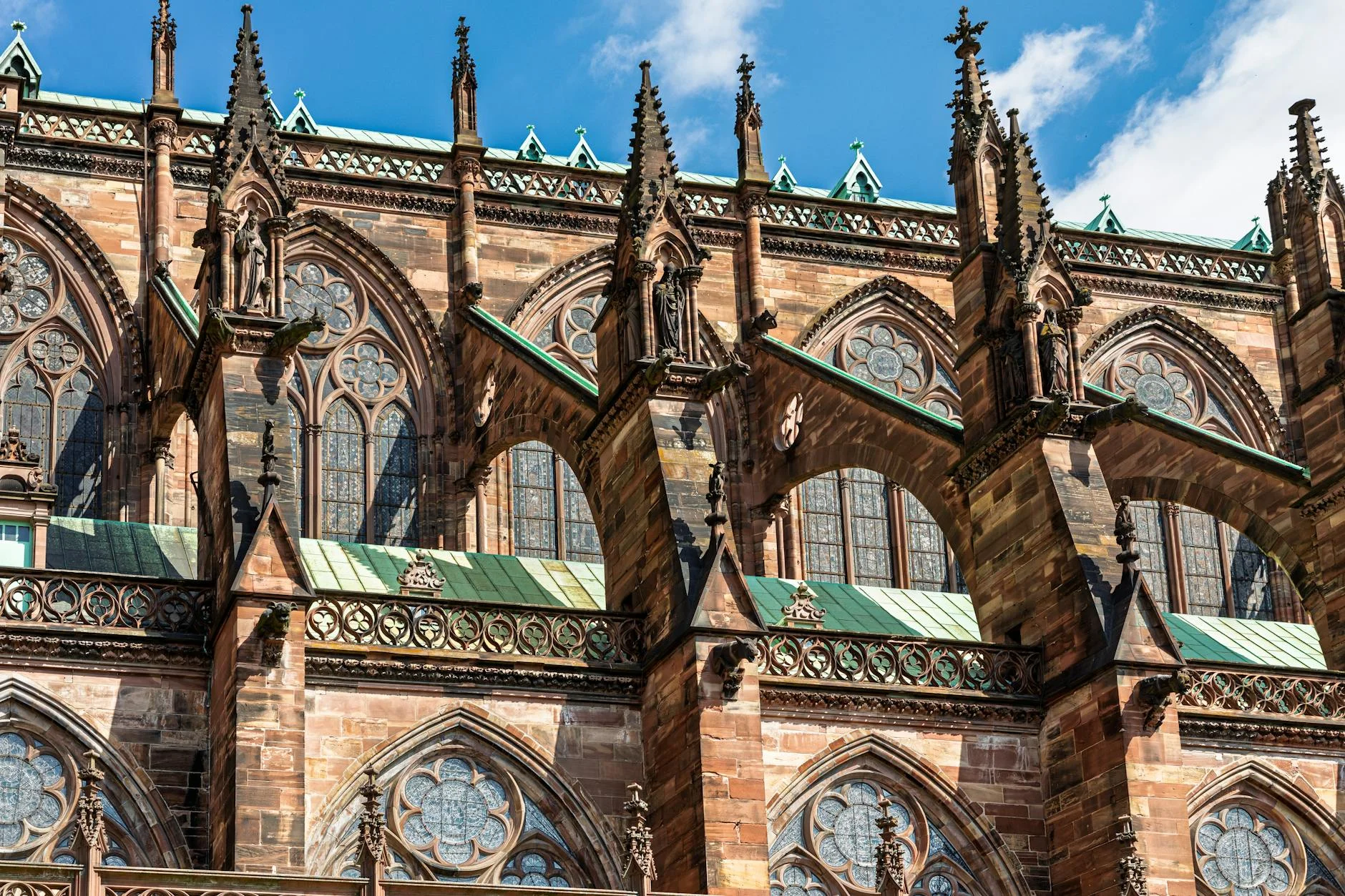
You see it before you arrive. From anywhere in Strasbourg's old town, the spire of **Notre-Dame Cathedral** pokes above the rooftops like a finger of pink stone pointing at the sky. At 142 metres tall, it was for more than two centuries — from 1647 to 1874 — the tallest structure ever built by human hands. That fact feels modest when you're standing at the foot of the facade looking up.
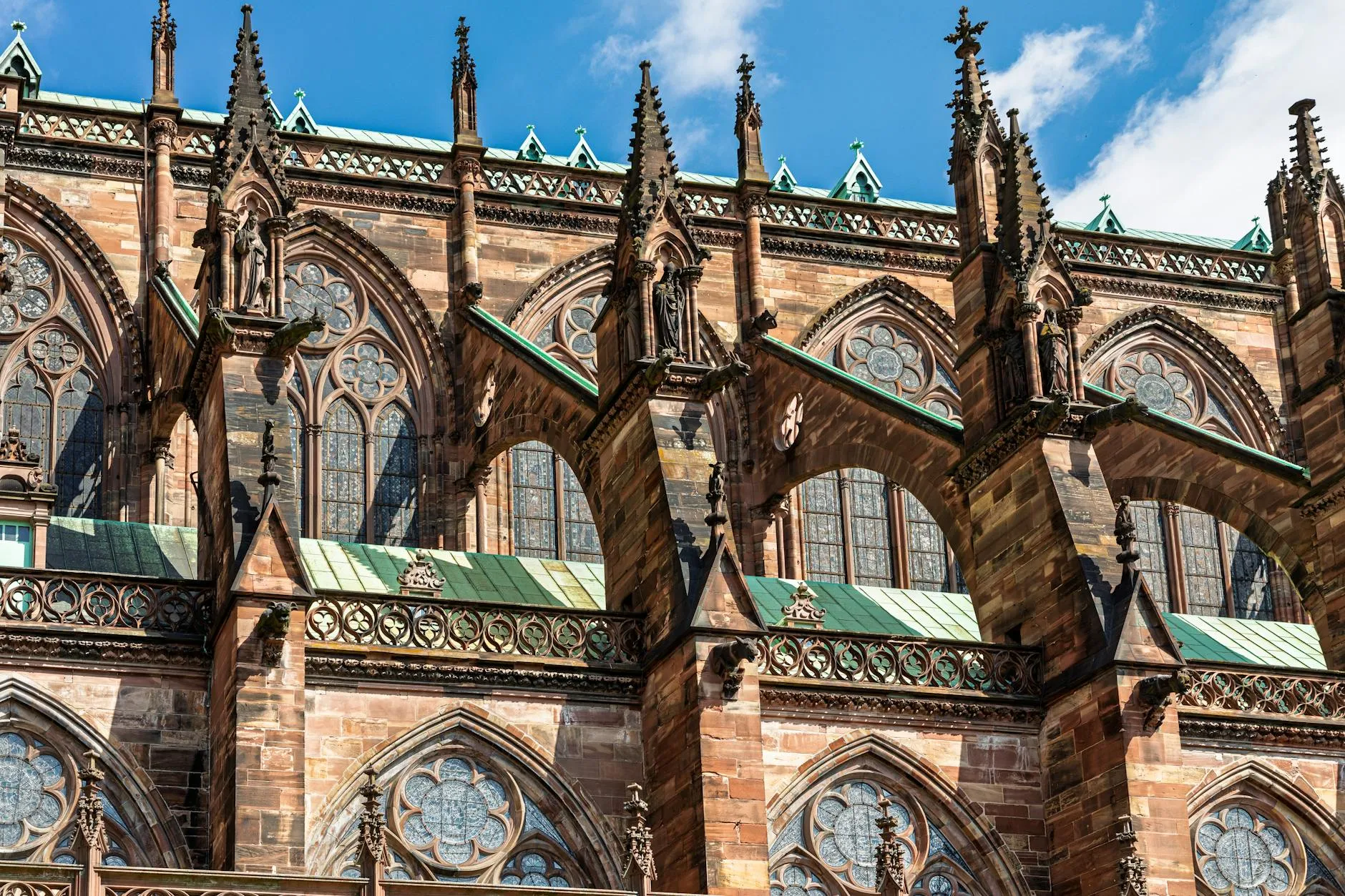
The western facade is a book of stone. More than 300 figures sculpted in **pink Vosges sandstone** narrate scenes from the Old and New Testaments with a level of detail that requires several minutes of observation to begin appreciating. The stone changes colour with the time of day: pale pink in the morning, coppery at noon, almost golden at sunset. Victor Hugo called it 'a prodigy of the gigantic and the delicate' — and for once, he wasn't exaggerating.
Construction began in 1015 in Romanesque style and continued for over four centuries, pivoting to Gothic in the thirteenth century. The result is a cathedral containing layers of architectural history: the original Romanesque crypt, the thirteenth-century Gothic naves, medieval and Renaissance stained glass, and the spire completed in 1439. Goethe, who studied in Strasbourg, climbed it regularly to conquer his fear of heights — and it was here he wrote his famous essay on German architecture that helped launch the Romantic movement.
Inside, light filtered through the **twelfth- to fourteenth-century stained glass** paints the floor with luminous mosaics that shift with the angle of the sun. The transept rose window, 15 metres in diameter, is one of the most spectacular in Europe. But the interior's crown jewel is the **astronomical clock**. Built between 1547 and 1574 by a team of clockmakers, mathematicians and artists, this 18-metre mechanism doesn't just tell the time: it calculates solar and lunar eclipses, equinoxes, planetary positions and movable liturgical feasts with a precision that remains valid today. Every day at 12:30, its mechanical automata spring to life: the apostles parade before Christ, a rooster crows three times and Death turns his hourglass. The daily crowd that gathers to witness the spectacle is proof that sixteenth-century engineering still amazes in the digital age.
**The 332 steps** to the panoramic platform are a narrow spiral staircase worth every gasp. From the top, Strasbourg unfolds in 360 degrees: the old town rooftops, the canals of Petite France, the European quarter to the north, Germany's Black Forest to the east and, on clear days, the distant silhouette of the Alps. It's the best context you can give your day in the city.
**Practical info**: free entry to the cathedral, €8 for the panoramic platform (€5 reduced). The clock show requires a €3 ticket granting access from 11:45. Arrive at least 15 minutes before 12:30 for a good spot. The cathedral opens from 7:00 to 11:15 and 12:45 to 19:00 — the midday break is for the clock.
About this activity
Strasbourg Cathedral is one of the masterpieces of European Gothic art. Its western facade, sculpted in pink Vosges sandstone, features over 300 figures narrating biblical scenes. The single 142-metre spire was the tallest structure in Christendom for two centuries. Inside, the 1574 astronomical clock still calculates eclipses and equinoxes with astonishing precision; daily at 12:30 its automata come to life. Climb the 332 steps to the platform for 360-degree views over Strasbourg, the Black Forest, and on clear days, the Alps.
Practical information
Book now
Reviews
Be the first to review this activity