Petite France
You cross a bridge over the Ill and the twenty-first century disappears.
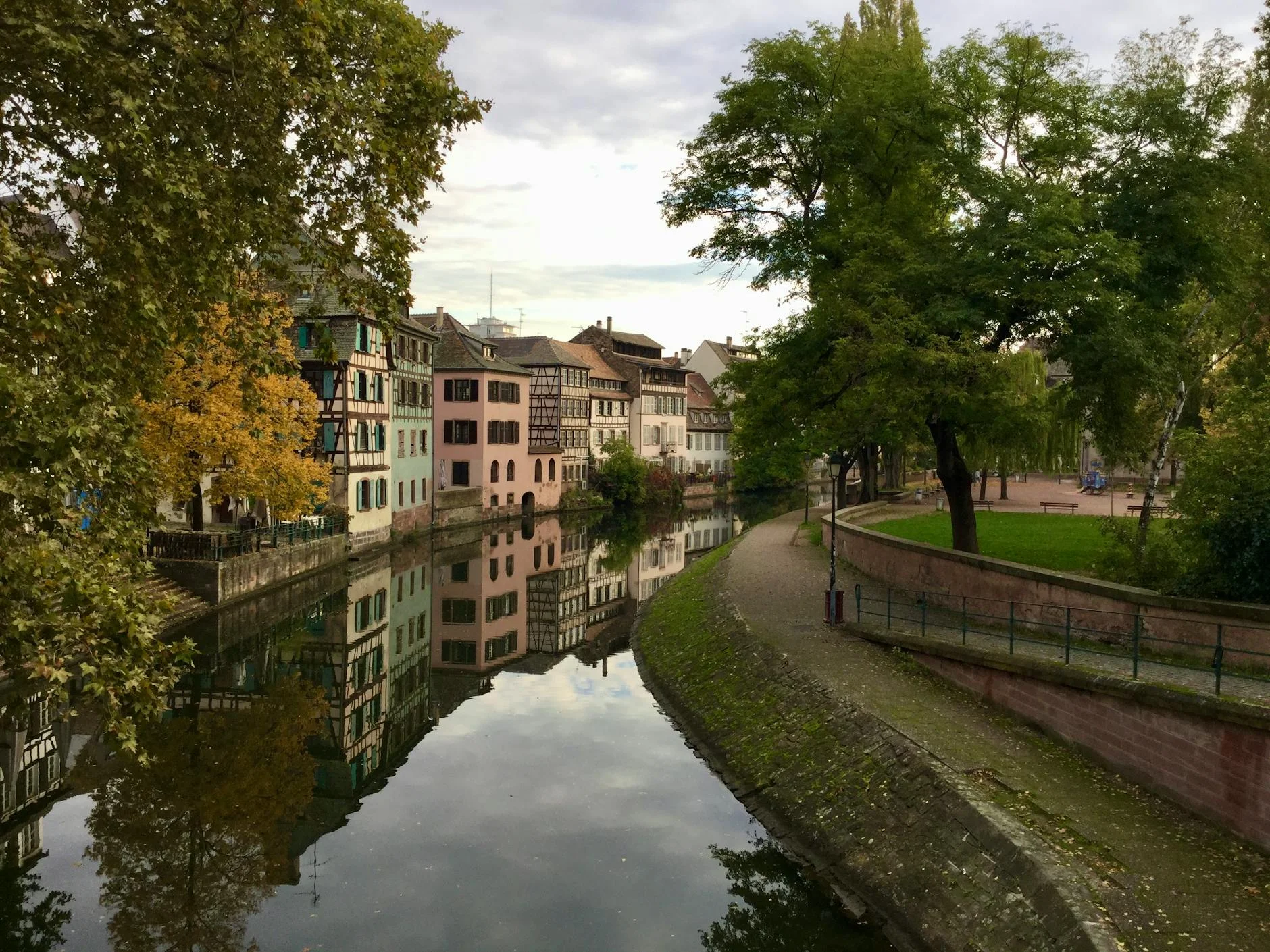
You cross a bridge over the Ill and the twenty-first century disappears. The cobbled streets of **Petite France** greet you with half-timbered facades that haven't substantially changed since the sixteenth century, balconies loaded with red geraniums and climbing roses reflected in the greenish canal water. The relative silence — there's always someone photographing something — is a radical contrast with the European quarter you've just left.
This neighbourhood was for centuries home to Strasbourg's toughest trades: **tanners, millers and fishermen** who needed direct access to the River Ill for their work. The half-timbered houses — colombages in French, Fachwerk in German — were built with their upper floors tilting towards the canal so tanners could dry hides in the open air. Today those same overhangs create the shadows and reflections that turn every corner into a postcard.
The name 'Petite France' isn't as romantic as it sounds. It dates from the sixteenth century, when a hospital was set up here to treat soldiers with syphilis — then known as 'the French disease'. The irony that Strasbourg's most photogenic quarter takes its name from a venereal disease is a reminder that history always has more layers than it appears.
The **Ponts Couverts** (covered bridges) are the medieval gateway to the neighbourhood. Built in the thirteenth century as part of the city's defences, their four watchtowers still stand even though the wooden roofs that gave them their name disappeared in the eighteenth century. From here, the upstream view towards the colourful houses is the iconic Strasbourg image that appears in every guide.
But the best viewpoint is a little further on: the **terrace of the Vauban Dam** (Barrage Vauban), built in 1690 by order of Louis XIV. The engineer Sébastien Le Prestre de Vauban designed this defensive weir with an ingenious function: in case of siege, the sluice gates were closed to flood the entire southern flank of the city, creating an impassable water barrier. Today the rooftop terrace is a free viewpoint with a complete panorama of the Ponts Couverts, Petite France and the cathedral spire behind. It's the perfect spot for a pause between activities.
Walking through Petite France at midday, when the sun lights up the colourful facades directly and reflections dance on the water, is a sensory experience that alone justifies the trip to Strasbourg. The quarter has been a **UNESCO World Heritage Site since 1988** as part of the Grande Île — the entire central island formed by the branches of the Ill. There's no entrance fee, no timetable, no price: you just have to be there and let the city do the rest.
**Practical tip**: avoid peak tourist hours (11:00–14:00 in high season). Early morning or at sunset, Petite France is almost intimate. If you need a quick coffee, the Maison des Tanneurs has the best canal-side terrace, though prices reflect the location.
About this activity
Petite France is Strasbourg's romantic heart and one of Europe's most photographed quarters. This former tanners' and millers' district preserves its 16th-17th century half-timbered architecture intact, with flower-laden balconies overlooking the Ill canals. The 13th-century covered bridges and 17th-century Vauban Dam form a UNESCO World Heritage ensemble since 1988. The Vauban terrace offers the best panoramic views.
Practical information
Book now
Reviews
Be the first to review this activity